Key Takeaways
1) The Australian R&D Tax Incentive supports eligible companies undertaking experimental activities to generate new knowledge.
2) Eligible R&D expenses may include salaries, contractor costs, materials, software subscriptions and equipment depreciation.
3) Routine development, standard business activities and unsupported expenditure can’t be claimed.
4) Accurate records and appropriate expenditure apportionment help reduce R&D claim risks.
5) Rimon Advisory combines technical, financial and compliance expertise to help businesses identify eligible R&D and prepare well-supported claims.
What Qualifies for the R&D Tax Incentive in Australia?
The Australian R&D Tax Incentive helps eligible businesses offset the costs of undertaking research and development.
However, not every innovative project qualifies. Businesses must demonstrate that their activities meet specific eligibility requirements and that their claimed expenditure relates to those activities.
Rimon Advisory helps Australian startups and R&D-intensive businesses identify eligible activities and expenses, prepare supporting evidence and navigate AusIndustry and ATO requirements.
Which R&D Activities Are Eligible?
The R&D Tax Incentive distinguishes between two types of activities.
Core R&D Activities
Core R&D activities involve experiments conducted to generate new knowledge. They must satisfy three key requirements:
- Unknown outcome: The outcome could not be known or determined in advance based on existing knowledge.
- Systematic experimentation: The work follows a progression involving hypotheses, experiments, observations, evaluation and logical conclusions.
- New knowledge: The activities are conducted for the purpose of generating new knowledge, including new or improved products, processes or services.
For example, a software company experimenting with different AI models to achieve a required level of accuracy may undertake eligible R&D if the outcome could not be determined in advance.
Simply building a new application using established techniques would not, by itself, qualify.
Supporting R&D Activities
Supporting activities must be directly related to eligible core R&D activities.
Examples may include preparing experimental equipment, collecting test data or developing components used in experiments.
What R&D Expenses Can Australian Businesses Claim?
Eligible R&D expenditure depends on the activities undertaken, how the costs were incurred and the applicable tax rules.
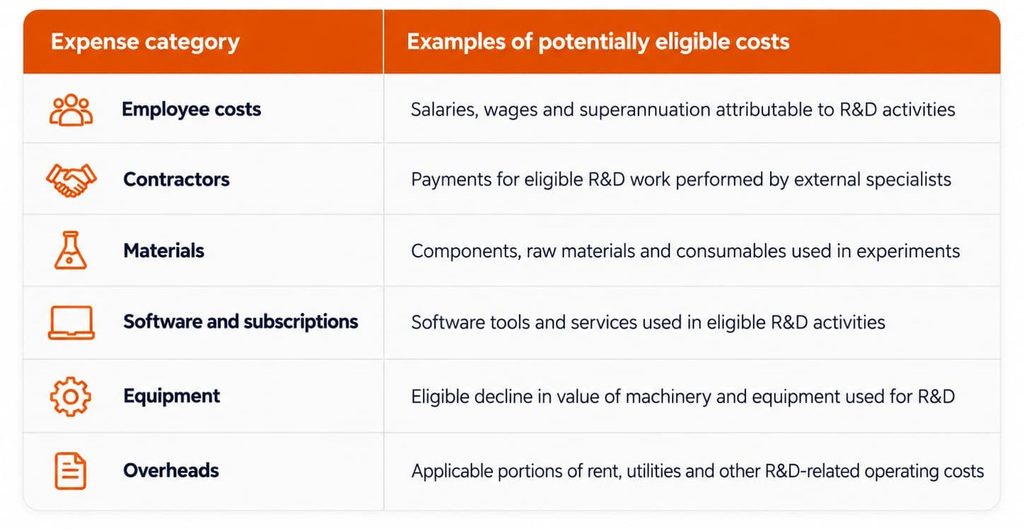
Where employees, equipment or services are used for both R&D and non-R&D purposes, the expenditure needs to be apportioned using a reasonable and supportable methodology.
Additional rules can apply to expenditure involving associates, feedstock, capital assets and activities undertaken for other entities.
How Much Can Businesses Receive Through the R&D Tax Incentive?
For the 2025–26 income year, the R&D Tax Incentive generally provides:
- Aggregated turnover below $20 million: A refundable tax offset equal to the company’s tax rate plus 18.5%. For a company subject to the 25% tax rate, this represents a 43.5% offset.
- Aggregated turnover of $20 million or more: A non-refundable offset with premiums of 8.5% and 16.5%, depending on R&D intensity.
The actual net financial benefit depends on the company’s circumstances, including its tax position and applicable adjustments.
Generally, companies must have at least $20,000 in eligible notional R&D deductions, subject to certain exceptions.
Common R&D Claim Mistakes to Avoid
Businesses can reduce compliance risks by avoiding several common mistakes:
- Claiming routine development: Not all software development, engineering or product improvements involve eligible experimentation.
- Claiming excessive employee time: Staff costs must reflect time attributable to eligible R&D activities, rather than assuming an entire role or project qualifies.
- Insufficient documentation: Businesses should retain evidence of technical uncertainties, hypotheses, experiments, results and conclusions.
- Incorrect expense allocation: Shared costs must be appropriately apportioned, and expenditure must satisfy the relevant tax requirements.
Maintaining contemporaneous evidence, such as testing records, project documentation, timesheets and financial records, can help support a claim during an AusIndustry or ATO review.
How Rimon Advisory Helps Businesses Claim Eligible R&D
Identifying eligible R&D requires both technical understanding and financial expertise.
Rimon Advisory brings together dedicated Technical, Financial and Compliance Teams to support businesses throughout the R&D Tax Incentive process.
Our approach includes:
- Technical assessment: Identifying eligible experimental activities and preparing AusIndustry technical report.
- Financial assessment: Reviewing expenditure and calculating eligible R&D costs.
- Independent compliance review: Reviewing claims before submission to identify potential issues and strengthen supporting documentation.
With over 14 years of experience and more than 2,000 R&D submissions, Rimon Advisory combines specialist knowledge with efficient, hands-on support to help businesses optimise their eligible R&D claims while managing compliance risks.
Frequently Asked Questions
Can software development qualify for the R&D Tax Incentive?
Yes. Software development may qualify where activities involve genuine technical uncertainty and systematic experimentation. Routine coding, standard integrations and implementing known solutions do not qualify simply because they form part of an innovative project.
Can startups claim the R&D Tax Incentive if they are making a loss?
Yes. Eligible loss-making companies may receive a refundable R&D tax offset, provided they satisfy the relevant requirements. The amount ultimately refunded depends on the company’s tax circumstances.
What evidence is needed for an R&D Tax Incentive claim?
Businesses should maintain technical records demonstrating their experiments and financial evidence supporting the claimed expenditure. Relevant records may include project plans, test results, GitHub commits, timesheets, invoices and payroll reports.
Get Expert Advice on Your R&D Tax Incentive Claim
Understanding which activities and expenses qualify is essential to preparing a compliant R&D Tax Incentive claim.
Rimon Advisory helps Australian businesses identify eligible R&D, optimise their claims and reduce compliance risks through specialist technical, financial and compliance support.
Contact Rimon Advisory to discuss your R&D eligibility and next steps.
About the author
Lior Stein | Co-Managing Director, Rimon Advisory
Lior Stein is a Chartered Accountant and Co-Managing Director of Rimon Advisory, with extensive experience in the Australian R&D Tax Incentive. He leads Rimon’s sales and marketing efforts and works closely with businesses to help them identify eligible R&D activities, maximise their potential benefits and navigate the claims process.