

Key Takeaways:
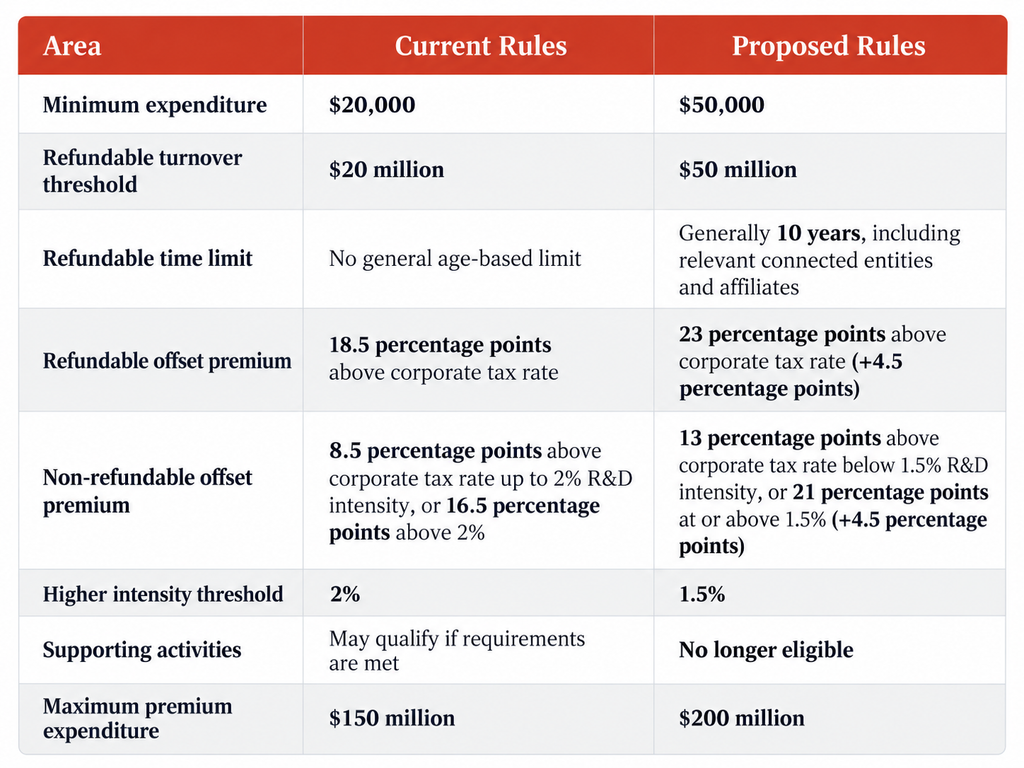
1) The minimum R&D expenditure threshold would increase from $20,000 to $50,000.
2) The turnover threshold for the refundable offset would increase from $20 million to $50 million.
3) A new 10-year limit would apply to the refundable offset in most cases, with connected entities and affiliates also relevant.
4) R&D tax offset rates would increase by 4.5% and the intensity threshold would reduce from 2% to 1.5%.
5) Supporting R&D activities would no longer be eligible.
6) Most changes are proposed to apply from income years commencing on or after 1 July 2028.
This article is based on the September 2026 exposure draft. The reforms are not yet law and may change before they take effect.
The Australian Government has released exposure draft legislation proposing significant changes to the Research and Development Tax Incentive (RDTI).
The reforms are intended to better target the program and encourage R&D investment that delivers broader benefits to the Australian economy. They are still in draft form and are not yet law.
At Rimon Advisory, we are closely monitoring the proposed reforms and what they could mean for Australian businesses undertaking R&D.
Minimum R&D Expenditure Threshold Would Increase to $50,000
Under the current rules, businesses need at least $20,000 of eligible R&D expenditure in an income year to access the R&D Tax Incentive.
Under the proposed rules, this threshold would increase to $50,000. Businesses with less than $50,000 of qualifying expenditure would no longer be eligible for the R&D tax offset unless an exception applies.
This could particularly affect start-ups and smaller businesses undertaking early-stage or lower-cost R&D. Existing exceptions for certain expenditure involving registered Research Service Providers and Cooperative Research Centres would continue to apply.
Refundable Offset Threshold Would Increase to $50 Million
The aggregated turnover threshold for access to the refundable R&D tax offset is proposed to increase from $20 million to $50 million.
This could benefit growing businesses that currently move from the refundable to the non-refundable offset once their aggregated turnover reaches $20 million. However, the higher threshold would be accompanied by a new limit on how long the refundable offset can be accessed.
New 10-Year Rule for the Refundable Offset
Under the proposed rules, an entity below the $50 million aggregated turnover threshold would usually only be able to access the refundable offset during the first 10 years from the relevant “start day”.
Importantly, the test would not look only at the R&D entity making the claim. Certain connected entities and affiliates would also be relevant. The start day is based on the earlier of when the R&D entity, or another relevant connected entity or affiliate, first started carrying on an enterprise or first registered for R&D activities.
This means a relatively new company may not necessarily receive a fresh 10-year refundable period if a connected entity within the group has a longer business or R&D history.
After the relevant 10-year period, an entity below $50 million turnover could still remain eligible for the highest proposed R&D offset rate, but the offset would be non-refundable. A special 15-year period is proposed for certain qualifying R&D relating to therapeutic goods.
R&D Tax Offset Rates Would Increase
The draft reforms propose increasing the relevant R&D tax offset premium rates by 4.5 percentage points. For businesses eligible for the refundable offset, the premium would increase from 18.5 percentage points to 23 percentage points above the corporate tax rate. For a company with a 25% corporate tax rate, this would increase the refundable offset rate from 43.5% to 48%.
For businesses using the non-refundable offset, the current premium rates are 8.5 percentage points for R&D intensity of up to 2% and 16.5 percentage points above 2%. Under the proposed rules, these premiums would increase to 13 percentage points below the new 1.5% intensity threshold and 21 percentage points at or above that threshold.
The practical effect for different turnover bands can be summarised as follows:
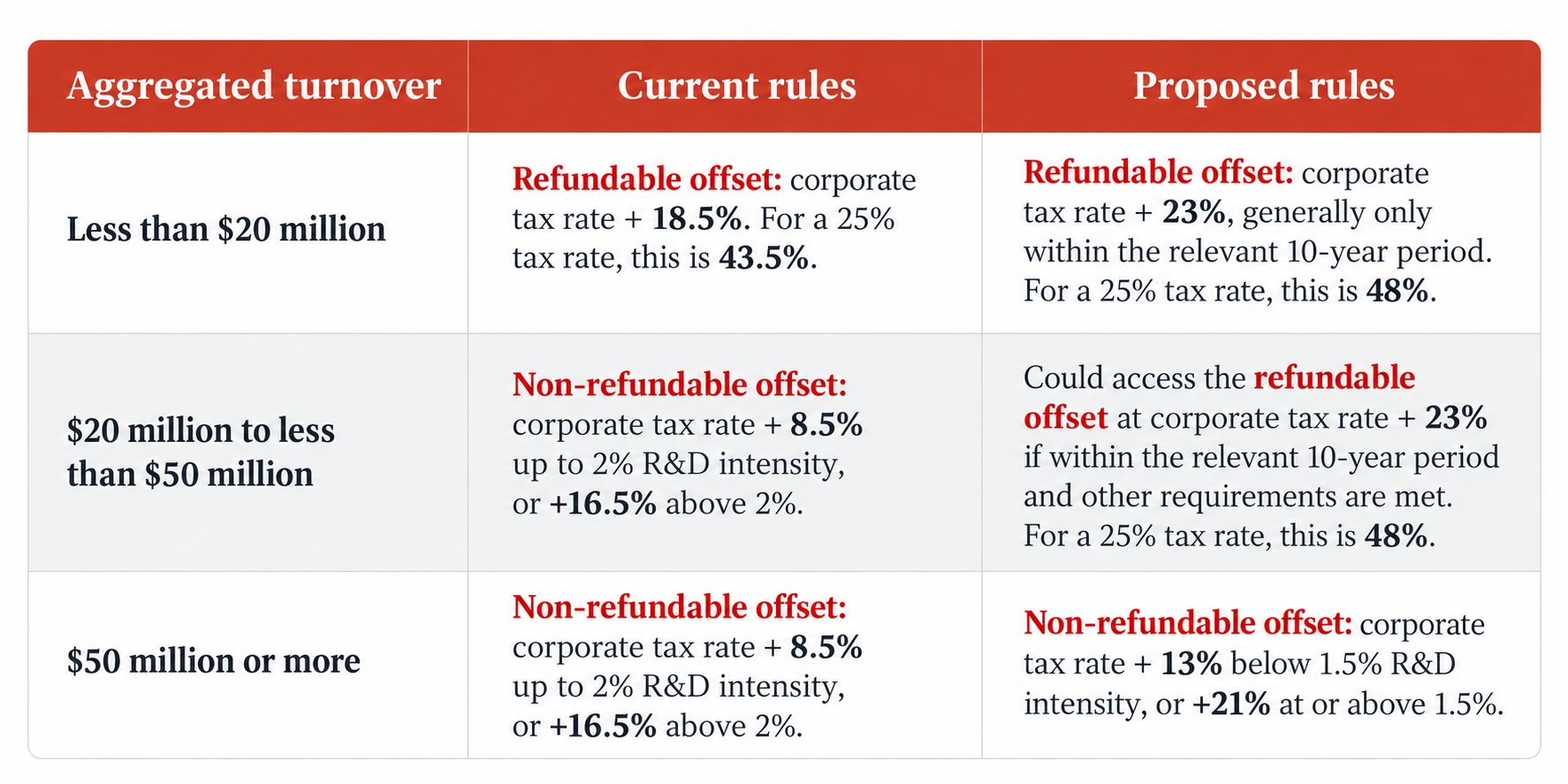
Rates shown above are expressed by reference to the applicable corporate tax rate. The 43.5% and 48% examples assume a 25% corporate tax rate.
Maximum Premium R&D Expenditure Would Increase to $200 Million
Under the proposed rules, the maximum amount of R&D expenditure eligible for the premium R&D tax offset would increase from $150 million to $200 million.
Supporting R&D Activities Would No Longer Be Eligible
One of the most significant technical changes is the proposed removal of the existing category of supporting R&D activities.
Under the current rules, a claim can include eligible expenditure relating to both core R&D activities and supporting R&D activities. Under the draft rules, the separate supporting activity category would be removed and “core R&D activities” would simply become “R&D activities”.
An activity would not qualify merely because it is directly related to, or undertaken to support, another eligible R&D activity. If enacted, this could narrow the range of project expenditure that businesses are able to claim and make clear activity scoping and documentation even more important.
Proposed RDTI Changes at a Glance
When Would the New Rules Apply?
The proposed amendments would apply to most assessments for income years commencing on or after 1 July 2028.
The draft includes transitional rules for certain supporting R&D activities undertaken before that date.
Businesses should not apply the proposed rules to current claims simply because the exposure draft has been released. The existing RDTI rules continue to apply unless and until the reforms become law and reach their relevant commencement date.
What Should Businesses Do Now?
For most businesses, there is no immediate need to change how current claims are prepared solely because of the exposure draft.
However, businesses undertaking long-term R&D should consider how the proposals could affect future claims. This includes whether future R&D expenditure is likely to exceed $50,000, how the 10-year rule may apply to the business and its connected entities or affiliates, and how much of a current claim relates to supporting activities.
Businesses should also continue maintaining strong evidence of the technical uncertainty investigated, the experiments undertaken and the expenditure connected to eligible R&D.
Rimon Advisory Is Staying on Top of the Changes
These proposals could represent significant changes to the R&D Tax Incentive, but they are not yet final and may change as the legislation progresses.
Rimon Advisory is closely monitoring the reforms and reviewing what they could mean for our clients and other Australian businesses undertaking R&D. Our Technical, Financial and Compliance Teams will continue to assess the proposed rules and provide updates as the position becomes clearer.
If you have questions about the draft reforms or how they may affect your current or future R&D claims, reach out to the Rimon Advisory team.
Practical FAQs and Scenarios
The examples below are based on the September 2026 exposure draft. The reforms are not yet law and may change before they take effect.
What happens if my company spends less than $50,000 on eligible R&D?
Under the proposed rules, a company with less than $50,000 of qualifying R&D expenditure would not be entitled to the R&D tax offset unless an exception applies. For example, if a company has $40,000 of qualifying R&D expenditure and no exception applies, it would fall below the proposed threshold. Existing exceptions for certain expenditure involving registered Research Service Providers and Cooperative Research Centres are proposed to continue
What if I am a start-up? How would these proposed rules affect me?
For a start-up that is within the proposed 10-year period and is not affected by an older controlling or connected entity, the refundable offset premium would increase by 4.5 percentage points, from 18.5% to 23% above the corporate tax rate. Assuming a 25% corporate tax rate, this would increase the refundable R&D tax offset rate from 43.5% to 48%. However, the start-up would need at least $50,000 of qualifying R&D expenditure unless an exception applies, such as eligible expenditure involving a registered Research Service Provider (RSP) or Cooperative Research Centre (CRC).
Importantly, supporting activities would no longer be eligible. In practical terms, the claimed activities would need to satisfy the proposed R&D activity requirements (formally referred to as core R&D activities) in their own right.
What if my R&D company is new but is controlled by a company that has been operating for more than 10 years?
This could affect access to the refundable offset. Under the proposed rules, relevant connected entities and affiliates can affect the start day for the 10-year limit. This means a newly incorporated R&D entity may not receive a fresh 10-year refundable period if a controlling company has already been operating for more than 10 years. It may still be eligible for a non-refundable R&D tax offset if the other requirements are met.
What if my company is more than 10 years old but still carries out eligible R&D?
The company could still be eligible for the R&D Tax Incentive, but the offset would be non-refundable once the relevant 10-year period has been exceeded. The proposed clock is not based only on when the company first made an R&D claim. It looks to the earlier of when the relevant entity started carrying on an enterprise or first registered for R&D activities.
What if my company has aggregated turnover of $30 million?
Under the current rules, a company with $30 million of aggregated turnover falls outside the refundable offset threshold. Under the proposed rules, the threshold would increase to $50 million, so it could potentially access the refundable offset if it is still within the relevant 10-year period and satisfies the other requirements.
What if most of my R&D claim relates to supporting activities?
Under the proposed rules, supporting activities would no longer qualify simply because they support an eligible R&D activity. If most of a company’s current claim relates to supporting activities, the amount it can claim could reduce significantly unless those activities satisfy the proposed R&D activity requirements in their own right.