

AI is everywhere. But does building with AI mean you’re doing eligible R&D? Not necessarily.
Australian businesses are investing heavily in artificial intelligence. From developing custom machine learning models to integrating ChatGPT into business software, AI is changing how companies build products and solve problems.
Naturally, this raises an important question:
Can you claim the costs of developing AI technology under Australia’s R&D Tax Incentive (RDTI)?
The answer is potentially yes. But there’s a big difference between using AI and undertaking eligible R&D involving AI.
And understanding that difference could be critical to your R&D claim.
First, What Actually Makes an AI Project Eligible for R&D?
One of the biggest misconceptions about the R&D Tax Incentive is that developing something innovative automatically makes it eligible.
Unfortunately, that’s not how it works.
You might be building a groundbreaking AI-powered platform that transforms an entire industry. But if you’re simply combining existing technologies in ways that are already understood, your development activities might not qualify.
The key question isn’t whether your product is innovative.
It’s whether you had to undertake systematic experimentation to resolve a technical uncertainty that couldn’t be answered using existing knowledge.
For example:
Scenario A: You integrate ChatGPT into your software to automatically summarise customer enquiries using an existing API. The implementation follows established methods and works largely as expected.
Scenario B: You’re developing an AI system that must reliably interpret complex, contradictory documents under strict accuracy and performance requirements. Existing approaches don’t achieve the required results, so your team develops and systematically tests alternative technical solutions.
Scenario B is much more likely to involve potentially eligible R&D activities.
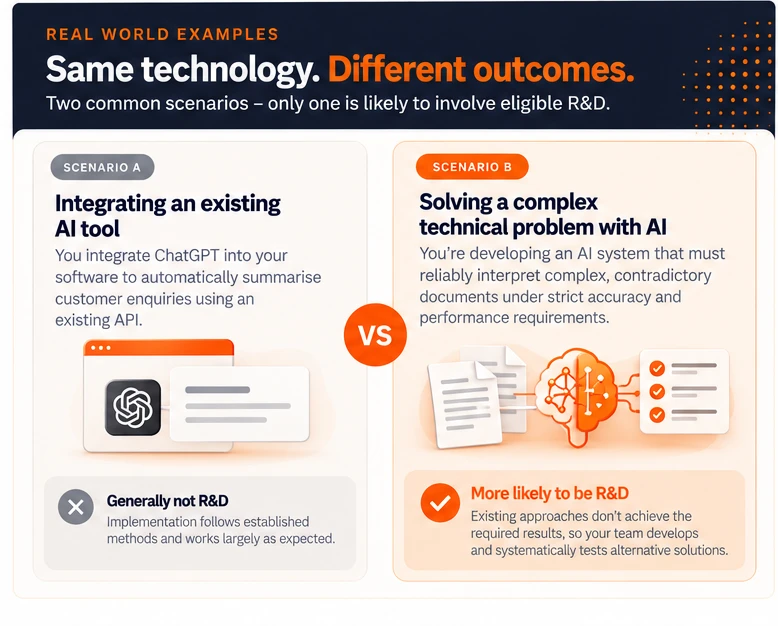
The difference? Genuine technical uncertainty and experimentation, rather than simply implementing existing technology.
Let’s look at how this applies to different types of AI development.
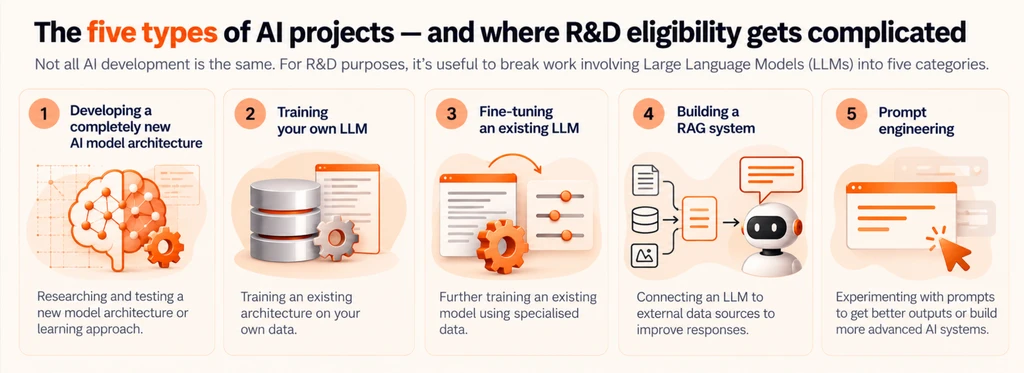
The Five Types of AI Projects and Where R&D Eligibility Gets Complicated
Not all AI development is the same.
For R&D purposes, it’s useful to break work involving Large Language Models (LLMs) into five categories.
1. Developing a Completely New AI Model Architecture
This is probably the clearest example of potentially eligible AI research.
Imagine your team is developing a fundamentally new neural network architecture designed to overcome limitations in existing models.
You’re not just applying existing AI technology. You’re investigating a new technical approach.
The work might involve:
- Developing new model architectures or learning mechanisms.
- Testing whether the proposed architecture performs as hypothesised.
- Experimenting with different technical approaches.
- Evaluating whether the new architecture offers measurable improvements.
The R&D angle: You’re potentially generating new technical knowledge through experimentation.
However, even here, R&D eligibility isn’t automatic. You still need to demonstrate that the technical outcome couldn’t be determined in advance and that the work meets the RDTI requirements.
2. Training Your Own LLM
What if you’re not inventing a new architecture, but you’re training a model using an existing one?
For example, your team takes an established open-source architecture and trains it on a specialised dataset.
The resulting model will have its own learned parameters and characteristics. In that sense, you’ve created something technically distinct.
But here’s the catch.
Creating a new model doesn’t necessarily mean you’ve undertaken eligible R&D.
If you’re following well-established training methods and the expected technical outcome is already understood, the work may simply be an application of existing knowledge.
On the other hand, if you’re facing genuine uncertainty about whether the model can achieve specific technical capabilities, and you need systematic experiments to find out, the position may be different.
The important question is not simply whether you’ve created a new model.
It’s what you needed to discover along the way.
3. Fine-Tuning an Existing LLM
Fine-tuning is becoming increasingly popular.
Rather than training an AI model from scratch, businesses take an existing model and train it further using specialised data.
For example, imagine a company developing an AI system to interpret highly specialised engineering documents.
An existing model performs reasonably well, but it struggles with technical terminology, unusual document structures and complex relationships between data points. The development team experiments with different training datasets, fine-tuning approaches and model configurations to try to overcome these limitations.
Could this qualify for R&D?
Potentially. But it depends on what the team is actually investigating.
If the fine-tuning follows a standard, predictable process, eligibility may be difficult to establish.
If the team is investigating an unresolved technical problem and testing competing hypotheses, there may be a stronger case.
The distinction is between routine model improvement and experimentation designed to generate new knowledge.
4. Building a RAG System: A Particularly Interesting Grey Area
Retrieval-Augmented Generation, or RAG, is one of the most common approaches businesses use to make LLMs more useful.
Put simply, RAG allows an AI model to access relevant information from an external knowledge source when generating a response.
For example, a legal technology company might connect an existing LLM to a database of Australian case law. Instead of relying solely on the model’s training data, the system retrieves relevant legal information to help answer questions.
Sounds innovative, right?
It certainly can be commercially valuable.
But that doesn’t automatically make it eligible for R&D.
When RAG Probably Isn’t R&D
Let’s say your team:
- Selects an existing LLM.
- Connects it to a vector database.
- Uses established embedding and retrieval tools.
- Implements a conventional RAG framework.
- Tests and improves the system’s responses.
If all of this follows established technical methods, it may be difficult to demonstrate that the team was generating new knowledge. After all, we already know that providing relevant external information to an LLM can improve its responses.
Simply demonstrating that it works with your particular dataset may not be enough.
When RAG Might Involve Eligible R&D
Now imagine the same company encounters a much harder problem.
Its AI system must retrieve information from thousands of complex legal documents, accurately identify conflicting precedents and produce reliable answers within strict processing-time limits.
Existing retrieval approaches cannot meet those requirements.
The development team begins experimenting with:
- New retrieval and ranking approaches.
- Alternative document chunking strategies.
- Methods to reduce hallucinations.
- Techniques to optimise context-window usage.
- Different approaches to balancing accuracy and response speed.
- More complex inference and orchestration architectures.
The team doesn’t know which approach, if any, will achieve the required technical outcome. This is where the R&D discussion becomes much more interesting.
The potentially eligible work isn’t necessarily building the RAG application. It’s the experimental work required to overcome the unresolved technical limitations.
That’s an important distinction for businesses developing AI-powered products.
5. Prompt Engineering: Can Experimenting with Prompts Qualify?
This is probably one of the trickiest areas.
Almost everyone working with LLMs has experienced it.
You write a prompt. The response isn’t quite right. You change the wording, add examples, adjust the instructions and try again. Eventually, you get a better result.
But is that R&D?
In many cases, probably not.
You’re simply using an existing AI model in the way it was designed to be used.
Improving prompts to generate better outputs may simply be routine optimisation of an existing capability. And testing different ways to use technology that is already known to work isn’t necessarily eligible R&D.
But What About More Advanced AI Systems?
Things can become more complicated when prompts form part of a broader experimental system.
For example, a company might be developing an autonomous AI agent that needs to complete complex, multi-stage tasks without human intervention.
The team encounters technical problems involving:
- Reliability across multiple reasoning steps.
- Maintaining consistency between AI agents.
- Preventing errors from accumulating across a workflow.
- Controlling model behaviour within defined technical constraints.
- Developing reliable self-correction mechanisms.
If established approaches cannot resolve these problems, the team may need to develop and test new technical methods.
In that situation, the potentially eligible activity may extend beyond ordinary prompt engineering into experimental software or systems development.
The key is identifying whether you’re investigating a genuine technical unknown or simply finding better ways to use an existing tool.
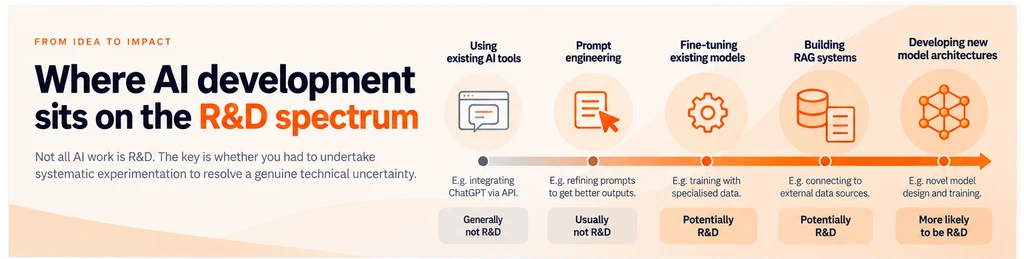
A Working AI Product Doesn’t Prove You Did R&D
Here’s something worth remembering.
Just because your team spent months developing an AI product doesn’t mean those months were all eligible R&D.
An AI project might involve a mixture of:
- Routine software development.
- API integrations.
- Data preparation.
- Model configuration.
- Experimental algorithm development.
- Testing and validation.
- Deployment and maintenance.
Some activities might qualify as core R&D. Others might qualify as supporting R&D where the relevant requirements are met. Some may not qualify at all.
The challenge is identifying exactly where the genuine experimental work took place.
This is particularly important because AI development often moves quickly, with teams constantly adjusting models, prompts, datasets and configurations.
Without clearly identifying the technical uncertainties and experiments, it can become difficult to separate eligible R&D from ordinary development.
What Records Should You Keep for an AI R&D Claim?
If you’re developing AI technology and think your activities might qualify, documentation is essential.
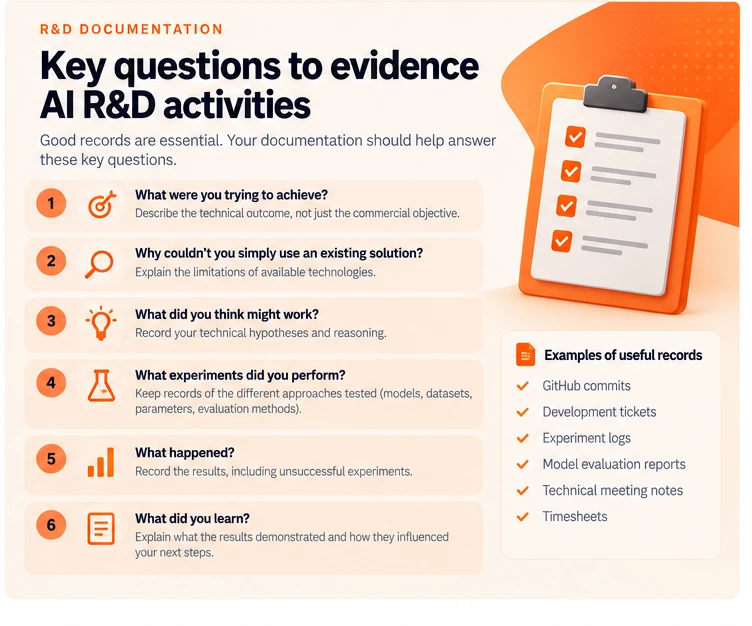
You don’t need to wait until the end of the financial year to start thinking about it. In fact, it’s much better if you don’t.
Your technical records should help answer a few straightforward questions.
What were you trying to achieve?
Describe the technical outcome your team was investigating, not just the commercial objective.
Why couldn’t you simply use an existing solution?
Explain the limitations of available technologies and why the outcome couldn’t be determined in advance.
What did you think might work?
Record your technical hypotheses and the reasoning behind them.
What experiments did you perform?
Keep records of the different approaches tested, including model configurations, datasets, parameters and evaluation methods.
What happened?
Record the results, including unsuccessful experiments. Failed approaches can be valuable evidence of the experimental process.
What did you learn?
Explain what the results demonstrated and how they influenced your next experiments or technical decisions.
Useful records might include GitHub commits, development tickets, experiment logs, model evaluation reports, technical meeting notes and timesheets.
The objective is to create a clear picture of the technical investigation as it actually happened.
Why AI R&D Claims Need Extra Care
AI is developing at an extraordinary pace.
Techniques that were genuinely experimental a few years ago may now be available through standard libraries, commercial APIs and well-documented frameworks.
This creates a challenge for R&D eligibility.
The more established and accessible a technical capability becomes, the harder it may be to demonstrate that applying it involves genuinely new knowledge.
Australian R&D decisions have also reinforced the importance of distinguishing genuine experimentation from the straightforward application or adaptation of existing knowledge.
In particular, the Body by Michael decision highlights the need to look beyond simply implementing known technology in a different context.
For AI businesses, that means being particularly careful about claims involving standard LLM integrations, conventional RAG implementations and routine prompt optimisation.
At the same time, it would be wrong to assume that using an existing AI model automatically rules out R&D.
There may be genuine technical uncertainties in how models are trained, adapted, integrated or orchestrated within complex systems.
The challenge is demonstrating exactly what those uncertainties were and how the experimental work sought to resolve them.
So, Is Your AI Project Eligible for the R&D Tax Incentive?
The bottom line is that AI development can involve eligible R&D, but using advanced technology isn’t enough on its own.
Whether you’re training a new model, fine-tuning an existing LLM, developing a RAG system or building autonomous AI agents, the same fundamental questions apply:
- Was there genuine technical uncertainty?
- Could the outcome be determined in advance using existing knowledge?
- Did you undertake systematic experimentation to resolve that uncertainty?
- Did the work seek to generate new knowledge?
- Can you demonstrate what you tested, what happened and what you learned?
If you can clearly answer these questions, you’re in a much better position to assess whether your AI development activities may qualify for the R&D Tax Incentive.
Developing AI? Speak to Rimon Advisory.
At Rimon Advisory, we work with businesses undertaking complex software and technology development, including projects involving artificial intelligence and machine learning.
Our team combines technical expertise with extensive experience in the Australian R&D Tax Incentive, helping businesses identify potentially eligible activities and understand the evidence needed to support their claims.
If your business is developing AI technology and you’re unsure whether your work qualifies, we’d be happy to help you assess it.
Contact Rimon Advisory to discuss your AI development project.
This article provides general information only. Eligibility depends on the specific activities undertaken and the applicable R&D Tax Incentive requirements.
Written by Davi Kofsky, Associate Director Rimon Advisory, published 13 May 2026.